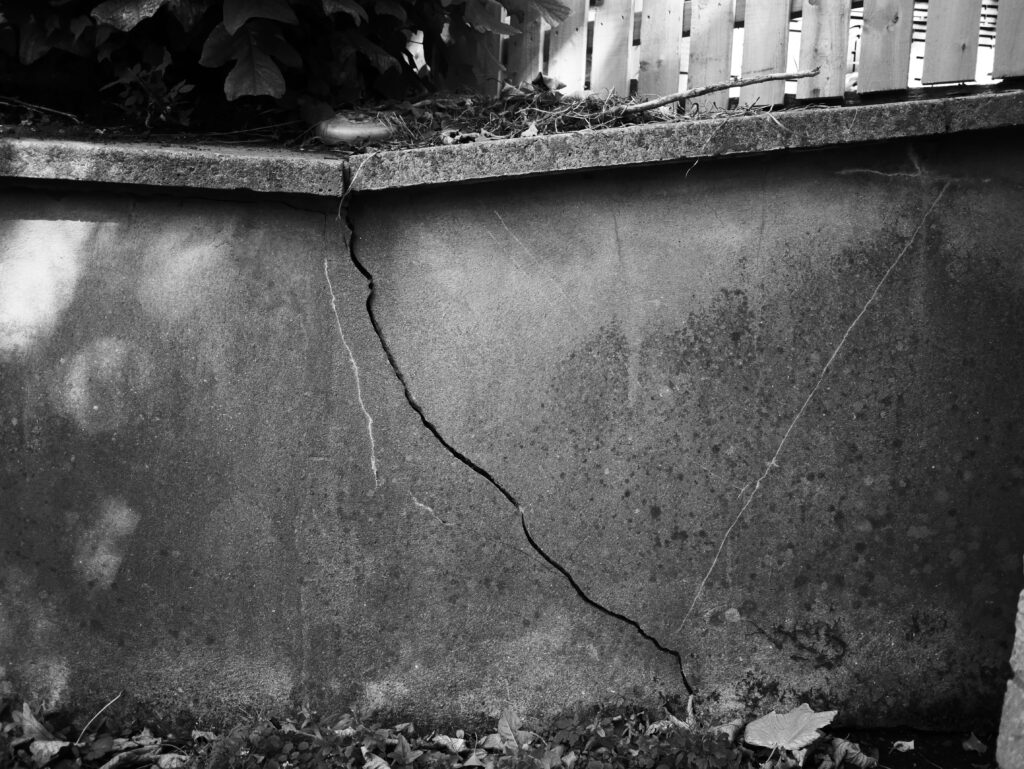
In his memoir Quand j’étais photographe (1900), the early French photographer Félix Nadar recounts a story about Honoré de Balzac, who was reluctant to have his picture taken due to his belief that the human body was made of numerous spectral layers, and that “[s]ince… man was incapable of making something material from an apparition, from something impalpable – that is, creating something from nothing – [Balzac] concluded that every time someone had his photograph taken, one of the spectral layers was removed from the body and transferred to the photograph. Repeated exposures entailed the unavoidable loss of subsequent ghostly layers, that is, the very essence of life”. Nadar is unclear as to how much faith Balzac placed in his own theory: he notes that the author of La Comédie Humaine sat for at least one picture in his life, which Nadar himself later came to acquire.
But let us humor Balzac for a moment, and assume that – in some sense at least – the image captured by the camera is not a likeness but a trace: less a representation than an efflux – a substance that has flowed out of its subject to be captured on celluloid (or in his case, on the silver-plated copper sheet of the earlier daguerreotype).
… a magical act takes place, akin to ritual extraction and subsequent ‘in-fixation’
The French semiotician Roland Barthes, in his essay on photography, Camera Lucida, at times seems to imply as much when he writes: “The photograph is literally an emanation of the referent. From a real body, which was there, proceed radiations which ultimately touch me…”; or a little further: “Every photograph is a certificate of presence”.
Barthes refrains from overtly magical thinking, although his tone is almost mystical at times, but he leads us down an easy path where photography begins to assume the form of witchcraft (from the Proto-Indo-European root *weyk-: to separate); where something is wrenched away from the subject before it is shared. This separation from the subject is then bound to a new support, be it paper, or temporarily, a screen (the Proto-Indo-European root *ser-, meaning “to bind together”, is also the root of the word sorcery). In capturing an image then – in the binding of an emanation to an object – a magical act takes place, akin to ritual extraction and subsequent ‘in-fixation’.
The photograph does not live, but neither is it entirely inanimate: a mute power radiates from it
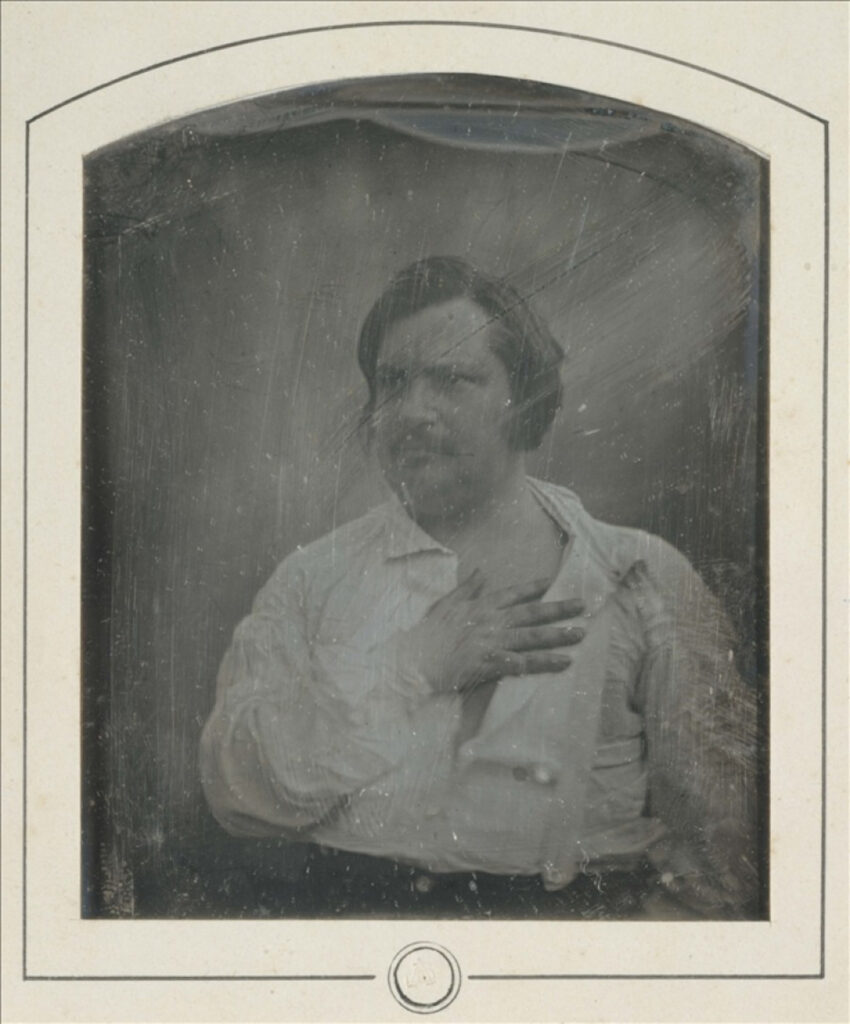
Let us consider the original 1842 Balzac daguerreotype, by Louis-Auguste Bisson: hand on his heart and dodging the camera’s gaze as if to avoid its spell, a larger-than-life Balzac strikes us in the sincerity of his pose. But there is another kind of sincerity at work here: the image’s own, Barthes would say. In Camera Lucida, while contemplating a photograph of his recently defunct mother, he writes: “What I had noted at the beginning, in a free and easy manner, under cover of method, i.e., that every photograph is somehow co-natural with its referent, I was rediscovering, overwhelmed by the truth of the image”. Whether he is looking at a picture of Balzac or of his mother, Barthes would note: “[t]he noeme of Photography is simple, banal; no depth: ‘that has been’”. The photograph does not live, but neither is it entirely inanimate: a mute power radiates from it. “[T]he thing has been there”.
From a fetish – a unique and sacred object in-fixed with an ethereal presence – the picture has become an infinitely reproduced egregore
We might pause here for a moment to remark that, even in the present age, when the medium has become utterly familiar to us, there still remains a magical dimension to the photograph. In its evolution from a single sheet of copper to celluloid reprinted on multiple pages of paper, and to bits of data infinitely distributed on digital screens, the photograph has morphed and moved on to Baudrillard’s third order of simulacra. Social media confronts us with highly curated, overly edited, and idealised images of life which no longer bear the materiality of the subjects they purport to represent. And indeed, this third order, Baudrillard calls “the order of sorcery”. Such sorcery, however, is of an entirely different kind than the binding-to-a-support we have discussed previously: a transmutation of the medium has taken place. From a fetish – a unique and sacred object in-fixed with an ethereal presence – the picture has become an infinitely reproduced egregore: a thought-form, created for and shared by a group, in which more often than not the subject has been dematerialised. The photograph no longer derives its power from what once touched it and which it absorbed, but from the collective gaze that now sustains and propagates it.
Were I to commit to a magical order, then it would have to be one of a third type: the order of conjuration
In this digital age, whilst I bemoan the loss of the fetish (a unique, tangible physical support), I confess that I am far too lazy a photographer (and too preoccupied with capturing the instant) to return to the heavy copper plate of the daguerreotype. But neither am I committed to the egregore, because it does away with the emanation itself – the “that has been”! Were I to commit to a magical order, then it would have to be one of a third type: the order of conjuration, for therein lies the historicity of the photograph. A summoning takes place: the summoning of what once occurred… the emanation from the referent is brought back to our awareness. Barthes, with a restraint and acuity that is typical of his writing, simply notes that, in the photograph, “the referent adheres”.
Camera Lucida was published in 1980, one year before the first Sony consumer digital camera entered the market, and almost a decade before the first image editing suites. We can only speculate as to what Barthes would have made of digital tools such as noise reduction, dehazing, masking, spot removal, or algorithmic highlights reconstruction. For to apply such tools is to enact an incision, with pixel-precise surgical sharpness, between the referent and its image. Manipulations of this kind break the spell of conjuration and thrust us straight into the order of sorcery, with the sole intent of creating an egregore that appeals to an audience brought up on airbrushing or Instagram filters. The shift they enact takes us from ‘that has been’ to ‘what should be’.
To perfection, in short, I prefer a more mundane truth, but not just a truth of the image: a truth of the event itself
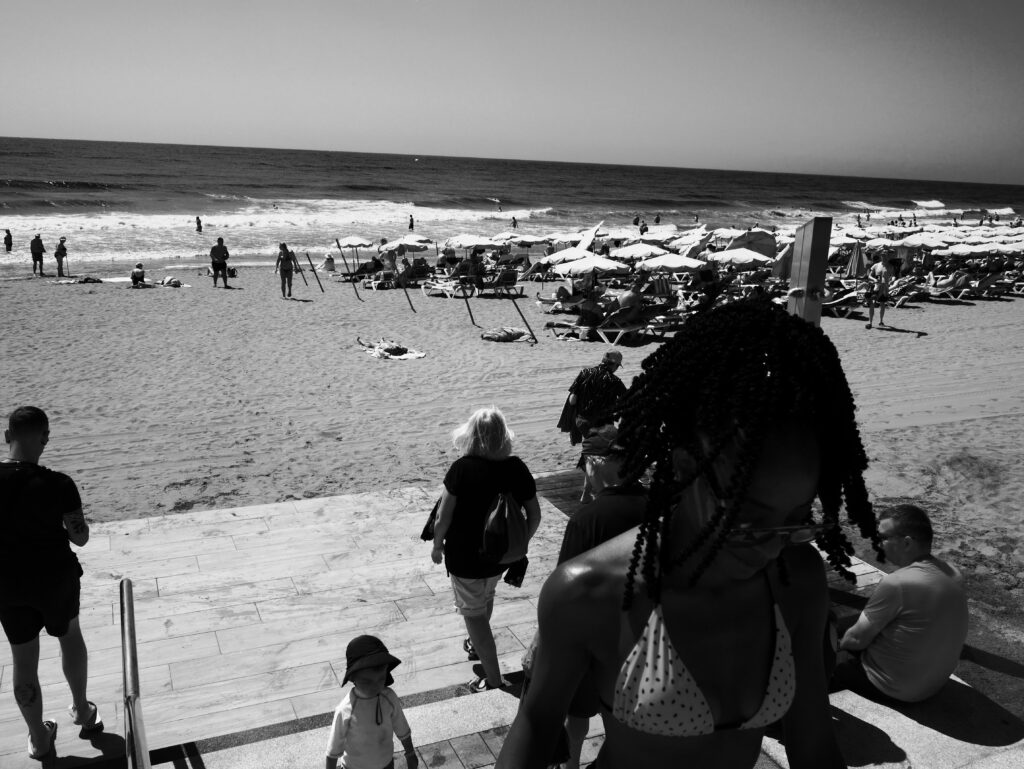
Take, for instance, this picture of a young woman exiting the beach after an afternoon in the sun. Here, I used a picture profile that was slightly too contrasty, losing some detail in the skin and blowing out the highlights in the sea foam. As a photograph, it would also benefit from a more formal composition, which I might have achieved through cropping and re-alignment… but none of this concerns me. For what would risk being lost in the process, beyond the faithfulness of that ‘emanation from the referent’, would be my presence in the scene. My fallibility as a photographer, and the tilt of my camera as I attempt to make myself unnoticed; the subtle way in which the young woman risks brushing her shoulder against mine as I make my way down the steps and click on the shutter unnoticed. To perfection, in short, I prefer a more mundane truth, but not just a truth of the image: a truth of the event itself, in which my presence and my unavoidable clumsiness cannot be so easily dismissed.
Most important of all to me, Barthes writes of the power of the image: “In the Photograph, the event is never transcended for the sake of something else: the Photograph always leads the corpus I need back to the body I see; it is the absolute Particular, the sovereign Contingency, matte and somehow stupid, the This (this photograph, and not Photography), in short, what Lacan calls the Tuché, the Occasion, the Encounter, the Real, in its indefatigable expression”. Certain details in a photograph ‘wound us’ Barthes would say, because they evidence the site of an encounter with the Lacanian Real: that space which cannot be expressed symbolically. Those details, Barthes calls ‘the punctum’: a “sting, speck, cut, little hole – and also a cast of the dice. A photograph’s punctum is that accident which pricks me (but also bruises me, is poignant to me)”.
Editing masks and anaesthetises… It blunts even when it sharpens
If the power of the photograph is to wound, then editing is not the cure such punctum demands (save, perhaps, for the photographer’s ego). Editing masks and anaesthetises; it offers the dullness of opiates in answer to the power of the fetish or of the conjured. It blunts even when it sharpens.
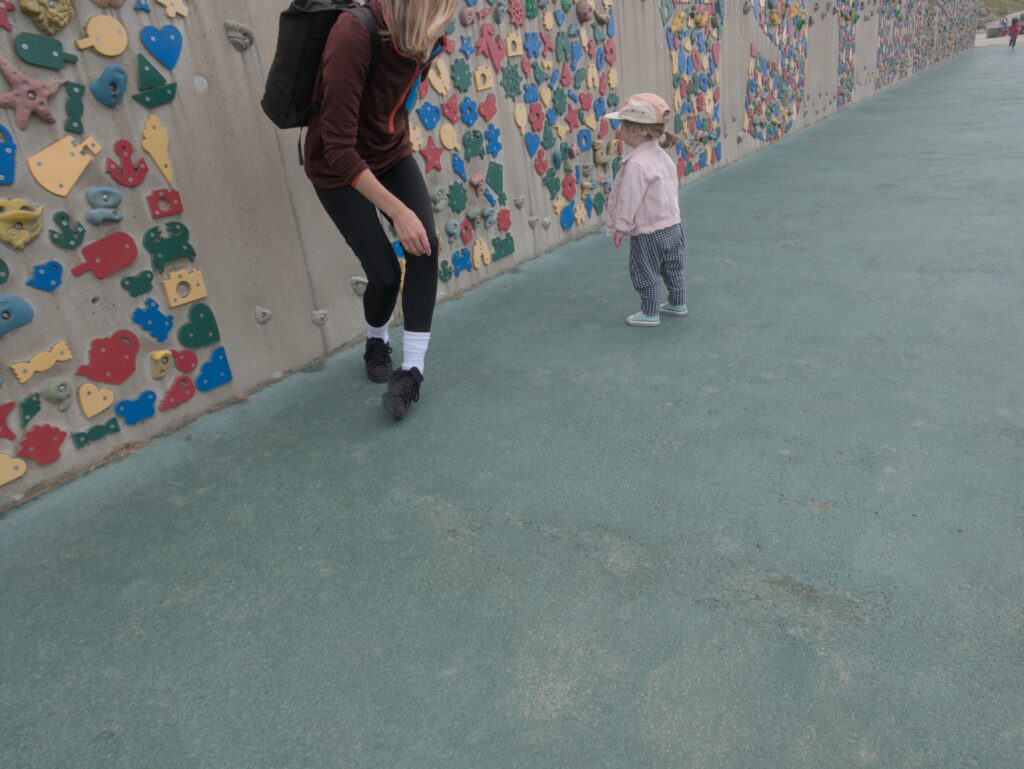
Barthes carries on: “The Photograph is violent: not because it shows violent things, but because on each occasion it fills the sight by force, and because in it nothing can be refused or transformed…”. His point is perhaps best illustrated by a second photograph of mine, taken on the promenade at Barry Island, Wales. In it, a mother watches her child as the girl is playing on the climbing wall that runs along the promenade. As someone close by shouts out, the woman turns around and twists her ankle at an awkward angle in the process. By all accounts it is a terrible picture, yet it is one of my favourites: the framing and alignment are off (I think I was as surprised by the call as the woman was), and the colours have a dull wash which the frequently grey skies in that part of the world tend to favour. The punctum, though – the wound that this photograph opens – is not the twisted ankle, but rather the expanse of wetpour rubber which covers that part of the pavement. It takes up over half of the frame, as if to call forth and to receive the fall of the young woman, or even the fall of the photographer himself. Or through him, his audience. The empty space in the picture overwhelms and unsettles. It is unashamedly untamed and unloved, perhaps because no one else would care to share it. It represents all that Instagram does not.
… the thoughtform or entity originally created and sustained by a collection of individuals has acquired an autonomy of its own
Barthes’ phenomenological approach to photography stands in contrast to that of earlier art critics such as Walter Benjamin or John Berger. Benjamin and Berger concern themselves with notions of authenticity and of ownership of an original, when art copies are so readily available all around us. To them, reproducibility marks the advent of art in the political sphere through its mass availability. In Art in the Age of Mechanical Reproduction, Benjamin writes that “the instant the criterion of authenticity ceases to be applicable to artistic production, the total function of art is reversed. Instead of being based on ritual, it begins to be based on another practice – politics”. Similarly, in Ways of Seeing, Berger notes that art has become “about social relations, not objects”. But both Benjamin and Berger deal with ways of seeing art, rather than with art itself as a way of seeing the world. Thus, to Benjamin, “mechanical reproduction emancipates the work of art from its parasitical dependence on ritual”. Barthes, on the other hand, insists on the irreducible noeme of the medium – that which cannot be absorbed – and to him, photography should aim to preserve the “that has been” in the face of politicisation. Unlike Benjamin or Berger, Barthes does not view the ascent of the photograph to the social or political sphere as an emancipation, but rather as a taming. He writes: “Society is concerned to tame the Photograph, to temper the madness which keeps threatening to explode in the face of whoever looks at it… The […] means of taming the Photograph is to generalize, to gregarize, banalize it until it is no longer confronted by any image in relation to which it can mark itself, assert its special character, its scandal, its madness. This is what is happening in our society, where the Photograph crushes all other images by its tyranny”. Perhaps by 1980, at the time of Barthes’ writing, the forces of capitalism have become such that they can easily absorb whatever emancipation has been brought forth by the democratisation of the art form. And perhaps, to return briefly to the concept of the egregore, the thoughtform or entity originally created and sustained by a collection of individuals has acquired an autonomy of its own. It is now propelled solely by the cultural logic of late-stage capitalism (or, in the 21st century, by the algorithms in which that logic has become embedded).
Such encounters tear through the representational fabric and enact a shift in the psychic economy
Ultimately, the choice we are confronted with as photographers, or as viewers and sharers of images, is the very same one Barthes contemplates in the ultimate paragraphs of Camera Lucida. He writes: “Mad or tame? Photography can be one or the other: tame if its realism remains relative, tempered by aesthetic or empirical habits (to leaf through a magazine at the hairdresser’s, the dentist’s); mad if this realism is absolute and, so to speak, original, obliging the loving and terrified consciousness to return to the very letter of Time… The choice is mine: to subject its spectacle to the civilized code of perfect illusions, or to confront in it the wakening of intractable reality”.
Photography, I have argued here, takes us from a mundane act (the clicking of a shutter to capture a memory, an event, or an aesthetically pleasing composition) to a magical one. Through its various forms, we move from a supernatural ontology (Balzac) to the simulacral ontology of Baudrillard. But it is Barthes’ phenomenological approach (which I have likened to the magical order of conjuration) which offers true power for change: it documents an encounter with the Real, that space where the symbolic order dissolves, and where only the image can convey what words do not. Such encounters tear through the representational fabric and enact a shift in the psychic economy. Where the fetish (the beloved photograph one carries in their wallet) is inward-focused, and the egregore (the edited image infinitely reproduced on social media) is easily absorbed by the dominant powers of society, only the conjured can usher in new ways of seeing and being in the world. Its power lies in its profoundly disruptive and wounding nature. It is in those images where the Real breaks through the surface of representation and unsettles the symbolic order, that other forms of sense-making find room to emerge and challenge the established consensus.
A few links:
Félix Nadar, My Life as a Photographer: https://www.jstor.org/stable/778642?origin=crossref
Balzac daguerreotype, by Louis-Auguste Bisson: http://parismusees.paris.fr/fr/oeuvre/portrait-dhonore-de-balzac , Public Domain, https://commons.wikimedia.org/w/index.php?curid=4993295
Roland Barthes, Camera Lucida: https://monoskop.org/images/c/c5/Barthes_Roland_Camera_Lucida_Reflections_on_Photography.pdf
Jean Baudrillard, Simulacra and Simulation: https://dn720006.ca.archive.org/0/items/baudrillard.-1970.-the-consumer-society/Baudrillard.1981.Simulacra-and-Simulation.pdf
John Berger, Ways of Seeing: https://www.ways-of-seeing.com/ Walter Benjamin, Art in the Age of Mechanical Reproduction: https://web.mit.edu/allanmc/www/benjamin.pdf