In his seminal 1967 work, The Society of the Spectacle, the French critical theorist Guy Debord defines the spectacle as “a social relation between people that is mediated by an accumulation of images that serve to alienate us from a genuinely lived life”. Thus, Debord suggests, images have become commodities through which all social relations are mediated. They mark a shift in consumer society “from having to appearing”.
Furthermore, for Debord, words no longer function as living carriers of meaning or thoughts, but rather they are also subsumed in the spectacle. They have come to assume the form of image-words – although Debord never uses that expression – and they manifest as freely floating, autonomous visual signs. In ‘spectacular’ society, attention is the currency of commodities, and thus speech finds itself reduced to slogans and aphorisms competing for the headlines.
The spectacle only accommodates what can fit on a placard
In such a landscape experts and public intellectuals are caught in a strange loop where to remain relevant means to tread a line that oscillates between idiocy and cowardice; between peppy catchphrases that do not hold and insipid intellectual retreats.
Spectacular slogans abound, on both sides of the political spectrum: “The personal is political”; “Good things are easily destroyed, but not easily created”; “Trans women are women”; “Facts don’t care about your feelings”. All capture an idea in a succinct and eloquent phrase which nonetheless fails to pay tribute to the complexities of the question they invite us to contemplate. All can be shouted to silence, other, and suppress; and ultimately all fail to achieve precisely that which – one would initially assume – they were designed to do: to persuade. The spectacle only accommodates what can fit on a placard: it fills the space and overwhelms the senses rather than trying to argue its case.
If attention is a currency, hyperbole is its gold standard – herein lies the end logic of the spectacle. Let’s take, for instance, French sociologist Bruno Latour’s catchy assertion (in the magazine La Recherche) that Ramses II could not have died of tuberculosis, as the disease had not been invented until 1882. Alan Sokal, a professor of mathematics and the author of Fashionable Nonsense, takes great exception to Latour’s remarks. To Sokal, Latour’s La Recherche article suffers from being one of those “ambiguous texts that can be interpreted in two different ways: as an assertion that is true but relatively banal, or as one that is radical but manifestly false. And we cannot help thinking that, in many cases, these ambiguities are deliberate. Indeed, they offer a great advantage in intellectual battles: the radical interpretation can serve to attract relatively inexperienced listeners or readers; and if the absurdity of this version is exposed, the author can always defend himself by claiming to have been misunderstood, and retreat to the innocuous interpretation”. Sokal thus accuses Latour of falling into a motte-and-bailey fallacy: having made a spectacular statement (“nothing we discover ever existed prior to its ‘discovery’”, in Sokal’s paraphrase of Latour), Latour then retreats to a much more defensible motte (scientific facts, when asserted, are socially constructed – my paraphrase).
Besides the fact that Sokal indeed entirely misunderstands Latour (who does not deny the existence of the thing-in-itself, but rather that scientists somehow have unfettered access to the noumenal, and thus that in the absence of such access, scientific facts are necessarily constructed), Sokal has a point in highlighting that Latour’s initial statement is “radical” and provocative. He is also certainly right that Latour deliberately conflates some concepts such as the ‘discovery’ of a bacillus with the ‘invention’ of a bacillus, although Latour’s rhetorical conflation seems deliberate and on point: it aims not to deceive, but to unsettle the familiar opposition of the two terms. But one could equally point out to Sokal that the pot is calling the kettle black here, since Sokal himself is no stranger to provocations, and no stranger to deception either (his somewhat unethical stunt in Social Text being a case in point)!
Beyond the very public controversy between two intellectual stalwarts, and whether or not the motte-and-bailey fallacy applies to Latour, who actually never backed down on his statement, it is worth noting that, in an attempt to gain notoriety or simply remain relevant, public figures of lesser calibre are often forced into such positions where spectacular (some would say idiotic) statements have to be counterbalanced with more measured (cowardly) intellectual positions. The choice appears to be one between hyperbole and retreat, between irrationality and irrelevance.
… the audience is no dupe
Yet, in recent years, a third strategy has increasingly come to the fore, offering an alternative to spectacular exaggeration followed by intellectual retreat: it is that which the German philosopher Peter Sloterdijk calls ‘cynical reason’: the perseverance of those who act ‘as if’ their statements were true. In the words of Slavoj Žižek, who makes heavy use of Sloterdijk’s concept in his book The Sublime Object of Ideology, those who resort to it “… know very well what they are doing, but still, they are doing it”. And such cynical reason manifests as the perfect antidote to the doomed motte-and-bailey strategy: those who utter such cynical statements see no need at all for a cowardly retreat to the motte; rather, they double-down on the bailey! Likewise, the audience is no dupe: far from being fooled by the catchphrase, they join in to the performance of it and willingly propagate it. Notions of truth and falsity become redundant and find themselves replaced with one of participation: the spectacular act is complete.

The wilful lie no longer belongs to the order of the imposition; it has entered the order of the meme.
In the modern political landscape, examples of such performative cynicism abound: slogans such as the one plastered on the infamous Brexit bus “We send the EU £350 million a week, let’s fund our NHS instead – Let’s take back control”; Trump’s tweet that “This was a stolen election”; Putin’s 2022 address to the citizens of Russia that “I made a decision to carry out a special military operation”.
What is interesting in these modern catchphrases and expressions, all products of right-wing populism, is that unlike under leftist totalitarian governments of old where people lived with the lie without ever fully endorsing it – where it was publicly reproduced out of coercion or self-interest, yet privately joked about – there is much more complicity in the endorsement of more recent examples (possibly to the exclusion of those of Putin). Where slogans were once repeated to survive or gain an advantage, they are now parroted in order to belong: participation in the spectacle is all about the enjoyment of disbelief. The wilful lie no longer belongs to the order of the imposition; it has entered the order of the meme. It spreads not through state enforced powers and ideological apparatuses, but through contagion.
The spectacle… becomes a spectacle of itself, and its audience an active participant in the enjoyment of its own performance.
Whereas right-wing populist slogans mainly seem to emanate from public figures (they are endorsed from the top down), radical liberal catchphrases, on the other hand, tend to come from the activists themselves. Calls that “trans lives are not a debate”, or that “I was born this way” point to an essentialism that is at odds with notions of gender as a social construct. Even more fundamentally, the universality of human rights, and their inalienability, are seldom put into question by leftist activists who otherwise verge towards moral relativism… Logical inconsistencies – just like plain falsehoods on the right – are temporally brushed aside in the participatory logic of the spectacle.
One wonders what a young Debord would have made of this turn of the 21st century. In The Society of the Spectacle, he writes: “The spectacle is ideology par excellence, because it exposes and manifests in its fullness the essence of all ideological systems: the impoverishment, servitude and negation of real life…”. Under the order of the meme, however, the spectacle no longer alienates by deception – it is not false consciousness. Spectacular man is not servile but integrated through irony and participation. Image-words do not hide the truth: they make communication redundant, flatten history, and conflate rebellion and entertainment. The spectacle in other words, becomes a spectacle of itself, and its audience an active participant in the enjoyment of its own performance.
A few links:
Bruno Latour – “Did Ramses II die of tuberculosis?”: http://www.bruno-latour.fr/sites/default/files/65-DASTON-RAMSES-GB.pdf
Alan Sokal’s comments on the New York Times Magazine’s profile of Bruno Latour: https://physics.nyu.edu/sokal/comment_on_NYT_latour.html
On the Sokal affair – Lingua Franca Magazine: http://linguafranca.mirror.theinfo.org/9607/tsh.html , and : http://linguafranca.mirror.theinfo.org/9607/mst.html
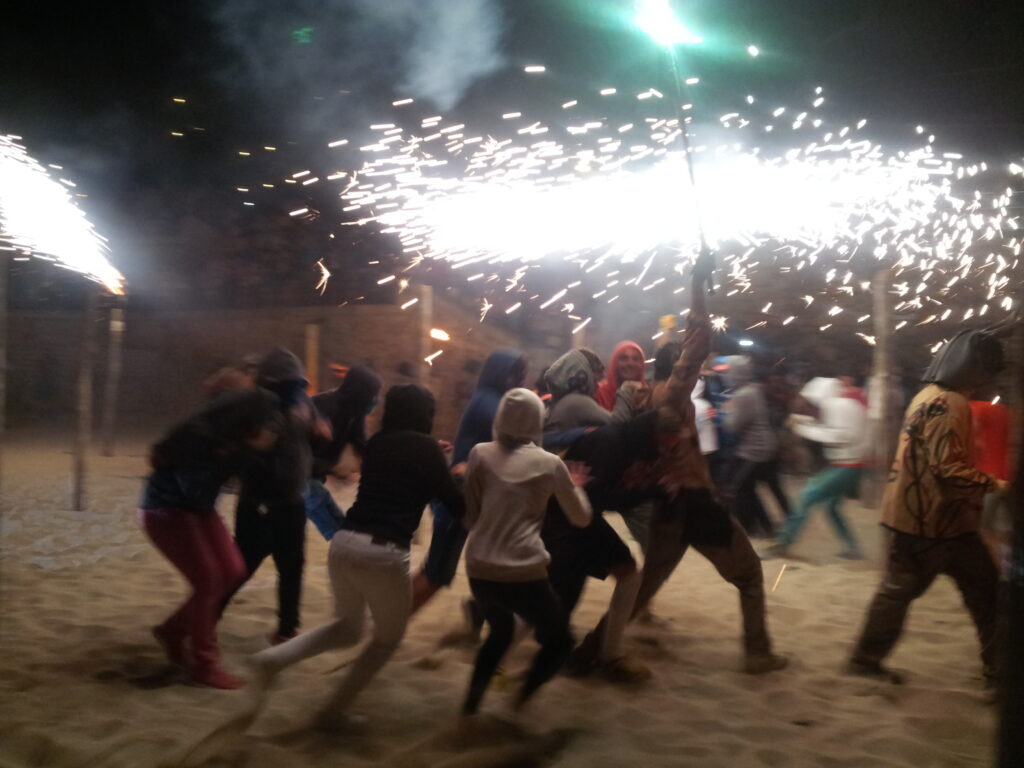
The pictures from this post are stills from a never-released short film, shot at the Palma de Mallorca correfoc in 2023, as well as pictures from the 2016 Portocolom correfoc.