Guy Debord and the Situationists would have no doubt disapproved of a typology of acts of urban resistance, or at least viewed it with suspicion. Not merely because of their distrust of analytical academic discourse, but because they saw classification itself as an act of neutralisation. To render resistance legible is already to risk domesticating it. Once made intelligible, acts of resistance become manageable and co-optable. This matrix however is not intended as an object of sterile contemplation for the psychogeographer, but rather as an instrument for intervention. It highlights the sites of friction within the city -sites that emerge primarily at the level of affordances– and it delineates a space of possibility for the creation of new situations. As such, it does not claim to be exhaustive, but merely serves as a framework from which hidden affordances can be extrapolated, tested, and explored.
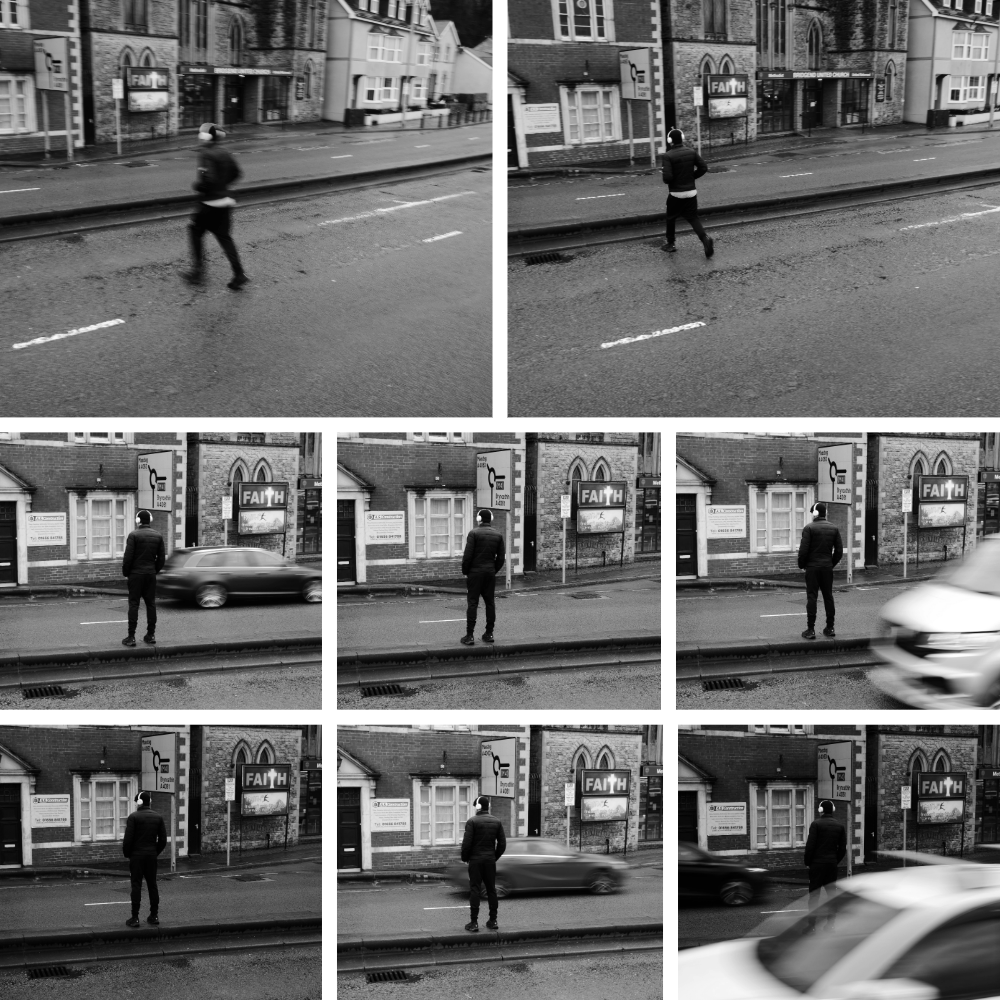
Photo montage: Jaywalking, or as it is more simply known in the UK, crossing the street
Methodology
In order to identify the sites of everyday resistance to the commodification of everyday life and of subversion of the urban order, a Marxist/Veblenian framework of production/consumption/leisure was initially considered. However, this framework was quickly found to be ill-fitted to these types of acts. The categories of ‘utilitarian’, ‘ludic & kinetic’, and ‘expression & performance’ eventually emerged, as they seemed to capture the main ways in which public spaces are used outside of working time. Those three types were then cross-classified against different ‘modes of resistance’ in order to draw up a typological matrix.
The modes of resistance themselves were primarily drawn from Letterist and early Situationist texts, as well as Michel De Certeau’s The Practice of Everyday Life, and Oli Mould’s Urban Subversion and the Creative City, both of which provided a historical and theoretical foundation for understanding subversive urban practices.
| ACTIVITY TYPES | ||||
| Utilitarian | Ludic & kinetic | Expression & performance | ||
| MODES OF RESISTANCE | Everyday Resistance | Loitering; crossing the street outside of pedestrian crossings; sleeping rough; urinating; public drinking | Running; street workout/exercise; stretching on infrastructure | Singing to yourself; whistling; alternative dress/style; boombox playing in public |
| Transgressive | Micro-transport; infractions in use of waterways, or road infrastructure. | Skateboarding; parkour; wild swimming; fight clubs; buildeering | Defacement of sculptures; padlocks on bridges; disruptive protests | |
| Illicit | Pickpocketing; dealing; stalking; shoplifting; barricades; riots; jaywalking | Street racing/ car cruising; cottaging; voyeurism | Exhibitionism; dogging | |
| Parallel Economies | Street vendors; begging; prostitution | Gambling (Mahjong); shell game (three cups and ball scam); bare knuckle boxing | Busking; street performance and theatre | |
| Occupation / Claiming | Squatting; picnics; tanning on lawns; guerilla gardening | Jianzi; street football | Occupy movement; protests | |
| Abstention | Refusal to vote; Boycott of institutions/commerce | Boycott of public events; rejection of competitive sports | Staged walkouts | |
| Spectacular Reappropriation | Marches? | Street karaoke; dancing; stunts (parkour, etc) | Street art; theatre of the oppressed; flashmobs | |
| Semiotic Reappropriation (Meaning-Making) | Vehicular/pedestrian shortcuts | Urban exploration; children’s games | Graffiti; Tagging; soapbox; culture jamming; détournement | |
| Recuperated | Cycle lanes; picnic tables | Skate parks; adiZones (exercise zones) | Commissioned murals; sanctioned performance zones | |
A disclaimer
This typology makes mention of acts that are illegal and/or -to some at least- morally objectionable. That such acts feature here does not in any way imply a condonation of them. However, it is unsurprising that they should appear in a list that is by its essence subversive, and the author implicitly accepts that, in the struggle to reclaim the streets and oppose the commodification of everyday life, the occurrence of such acts is inevitable. A necessary evil, some may say, although one which can potentially be tempered through other means.